JüS marked down

Hanover and Transvaal

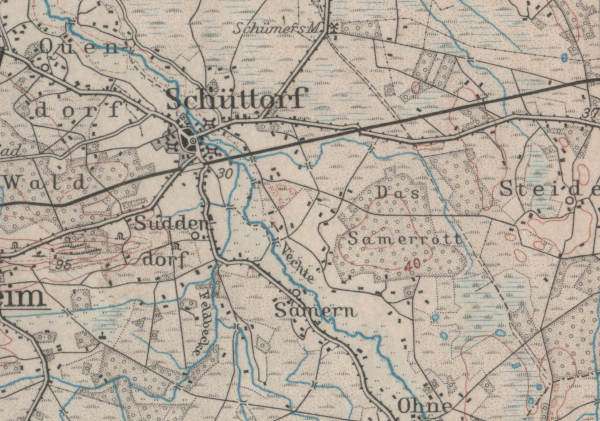
Schüttorf and Pretoria

The reason for my interest in the history of Schüttorf (Germany) and Pretoria (South Africa) is as simple as it can be: I have lived in both cities.

Yet, there is a surprising connection between the two places, because the ancestors of the name giver of Pretoria had once begun their migration in Schüttorf. Barend Wesselszoon Pretorius had been born around 1596 in Schüttorf. He was a shoemaker, and as a young adult he had moved to Leiden in The Netherlands, where he had been burried in 1669. His grandson Johannes Pretorius (1642-1694) belonged to the first generation of European settlers at the Cape of Good Hope. The Dutch Vereinigde Oostindische Kompagnie (VOC) had established a refreshment station for their ship, circulating between Batavia and The Netherlands.

Cape Town wasn’t meant to become a colony, and the VOC was eager to prevent financial and military commitment in South Africa. This caused tensions with those who wanted to make a living in the new territory, which in turn caused tensions with the local people. This didn’t change much, after the British had subjugated the Cape in 1806, to keep it as a strategic military post themselves. Yet, it added the conflict between constitutional British and still feudal Dutch settler modes of politics to the existing conflicts.

This set the stage for the last migration of these antecendents. As result of the conflict, a few thousand Dutch speaking farmers on the eastern border decided to move northwards in 1836. Andries Wilhelmus Jacobus Pretorius, in the fifth generation after the first South African Pretorius, established himself as one of the political leaders. In 1852, he negotiated the Sand River Convention with the British. It ruled an area of autonomous political self-determination, including the usual imperial ignorance of African interests, for the settler beyond the Vaal - Transvaal.

Martinus Wessel Pretorius, son of Andries Wilhelm Jacobus and in his name still traces of the Wessels from Schüttorf, founded in 1855 the city of Pretoria at the place of his father’s farm, and made it the capital of the Zuid-Afrikaanse Republiek in 1860.

: Pretoria received its name from Martinus Wessel Pretorius in rememberance of his father Andries Wilhelmus Jacobus Pretorius, who had settled there. Andries Pretorius was responsible for an agreement between the Bristish Empire and a bunch of Dutch speaking settlers, to mark the Vaal river as a border of influence. North of it, the settlers could build theit own state(s) - from the British perspective “beyond the Vaal”, hence Transvaal. The settlers themselves would call it Zuid-Afrikaanse Republiek.

To a certain degree, the Sand River Convention brought a long migration to an end - which had begun in Schüttorf. One And is grandfather Whenever this hobbyhorse becomes apparent, there is a standard question for the philatelist: “What is your most valuable stamp?” It is caused by the widespread societal knowledge that this dry-as-dust hobby is somehow connected to the Blue Mauritius, which has become a symbol for scarcity and valuables far beyond the realms of philately.

Letter from Nylstroom, 1913 A letter with Union of South Africa SG No. 2, Orange River Colony SG No. 48 from 1913

Yet, stamps are indeed a good example to explain the generation of value in modern society. The introduction of these postal fee labels (aka stamps) in 1840 initialised the establishement of a global communication network within a few decades only. Until the 1990s, when the Internet took over, the postal systems were a core component of states.

In these systems, stamps had lost their crucial role early on. In 1864, Prussia allowed to use Franco postmarks instead, later on followed by franking machines. Instead, stamps had become the standard for private communication of ordinary people. In the non-commercial context, stamps got the attention that developed stamp collecting into the cultural practice of philately.

Because of the monetary value and economic importance, the protection of stamps against counterfeiting was an important issue from the beginning. The line engraving of illustrations in the first priniting plates, and the preparation of special papers, and then the modes of perforation of single stamps in a sheet all applied artisanship for the protection of origin. In other words, the beauty of stamps derived from the prevention of fraud.

The circulation of masses of stamps in the communication of society motivated the idea of including implicit and explicit messages. So, the technical options of protecting against counterfeiting, the artistical opportunity to generate a small image, and the political intention to spread a message began an interplay that caused the continual issuance of stamps.

The idea of collecting stamps was at hand from the beginning. If more persons are interested in possessing one item, it generates value - at least for the interested persons. The first catalogues for collectors appreaed in the 1860s, which means that the generated value was sufficient to create business opportunities.

The nearly disappearance of stamps from daily communication makes the standard question to collectors - “what is your most valuable stamp? - somewhat laughable. Of course, there are some famous and valuable philatelic items, like with any other product of artisanship. Yet, the value of most collectors’ stamps are generated by themselves, as a result of their effort to build up a meaningful collection.

Some collect specific countries, some look out for motives, some document certain postal routes or means of transportation. Stamps as traces of the past can be damaged or destroyed and may get lost - hence it becomes a challenge to enrich and complete a collection. Yet, the value derives from the want of the collector alone. Stamp collecting is a caregiving to culture and history.

Source of this page

This hobbyists’ page is located at sdf.org, a great place for learning and fun. The author is sociologist and statician, promoting free software and democracy and philately, which are quite intimately linked to each other, because they are all about the option of freely communicating for the purpose of finding a common way ahead.

For contacting me, you can refer to @jues@mastodon.sdf.org on your favourite Mastodon instance or e-mail with or without this public gpg-key.

Jüs van Diek

This webpage runs on the public Unix system of sdf.org. It’s a great place for learning and having fun.

I’m running a workstation with Fedora and a laptop with CentOS Stream. I am happy to assist anybody in the turn away from proprietary software.

My scientific publications are recorded at ORCID.